By Mirco Stella and Hilarius Kofinti
January 2022
Since September 2021, 39 students enrolled in the Bachelor of Educational Studies at the Faculty of Education of York University (Canada), through the BHER project, have developed and delivered community-centered workshops in their local schools. With some exceptions, the overwhelming majority of these students are refugees who are employed as primary teachers by INGOs, including Lutheran World Federation (LWF). They work and live in a situation of protracted displacement in one of the largest Refugee Complexes in the world, located in Dadaab (Kenya).
The workshops delivered constitute the main requirement for the students’ final year practicum course titled “Experience, Inquire, Contribute II: Systematic Observation in Context” (EDST 4999X). The practicum course represents a milestone for students: a unique academic and professional opportunity to work in the existing disconnections and gaps between theory and practice in the field of education. In this generative space, students work collectively and are tasked with bringing together ideas, knowledge and skills acquired throughout their studies, while verifying the potential impact of educational research in dialogue with their wider communities. The course also offers a space to critically reflect on and engage limits and possibilities arising as they undertake collective inquiries to ameliorate and transform their present professional and lived environments. Furthermore, as part of the formative assessment for the course, students use collective portfolios to document the process of workshop development and facilitation and then proceed to write fieldwork essays, individually or in small groups, to reflect on challenges and achievements.
This preliminary write-up reflects some of the insights gained from the students’ observations garnered from the workshops thus far. These were drawn from student portfolios and reflections presented to course directors, Mirco Stella and Hilarius Kofinti, in the last class for the Fall 2021 term.
Throughout the Fall term, students have been working in six (6) groups to mobilize parents, families and the larger school community in the three (3) camps in Dadaab – Hagadera, Ifo and Dagahaley- and raise awareness on the Competency-Based Curriculum (CBC) introduced by the Ministry of Education in Kenya. “The Big Shift”, as the CBC has been labeled by the Kenya Institute of Curriculum Development (KICD), promises to deliver a new system that will prepare all children and youth in Kenya for the dynamic global knowledge economy of the present and future (KICD, 2021). The 7 core skills and mindsets, which include digital literacy, citizenship and collaboration, represent a commitment to a learner-centered pedagogy that also appears to increasingly redraw and extend the boundaries of education beyond the classroom walls. Parents, defined as “the first educators, trainers and sources of authority” for their children (KICD, 2021), are thus identified as crucial allies in instilling the founding values and mindsets of the new curriculum, including learners’ self-efficacy and lifelong commitment to learning.
Each of the six (6) groups of student-teachers has thus reached out to PTAs (Parent Teacher Associations) and BOMs (Board of Managers) and after extensive consultation and recruitment has already successfully negotiated, organized and facilitated two (2) workshops, attended by ten (10) to fifteen (15) participants from their respective communities. As a result, a total of twelve (12) workshops have occurred in six (6) different primary schools, and 83 parents, members of children’s families or communities have been mobilized. For many of these participants, the opportunity to attend such workshops held great individual and historical significance: they had never participated in such a space before and were mostly unaware of the implementation of the new curriculum or their expected engagement and roles.
Thus far, two rounds of workshops have occurred: 1) a Consultation round in which student-teachers engaged participants in preliminary conversations about the space while gauging the community’s prior knowledge of the CBC; 2) a second round focused on an overview of the Competency Based Curriculum Framework in Kenya (2019) and the Guidelines of Parental Empowerment and Engagement (2019) issued by the Kenya Institute of Curriculum Development (KICD). Specifically, student-teachers presented participants with the new learner-centered approach to school and lifelong competency-based framework to learning. They explained that with the walls between classrooms and communities being effectively collapsed, the demands on the communities of students grow significantly. Parents are now being called on to: a) identify and nurture the talents of their children; b) guide, motivate and actualize some of the school activities; c) provide aids, materials and instruments required for the learning; d) collect and send evidence of completed school tasks to teachers; e) overall complement teachers’ efforts (Amunga et al, 2020; KICD, 2019b).
In line with research consulted (Amunga et al, 2020; KICD, 2019b; Wafubwa, 2021), students have reported contrasting findings. On the one hand, parents and families are ultimately excited about these spaces, about the empowerment that the CBC promises, many are even eager to commit their time to future workshops and to acting as community educational leaders, by inspiring other parents and families to engage, make some changes to the way they relate to schools. Furthermore, they appeared particularly engaged and participated extensively in the workshops with many follow-up questions and concerns which students noted and responded to. In this sense, there is hope that perhaps the CBC may in fact assist in overcoming the overwhelming realities of scholastic disenchantment and marginalization experienced in the Refugee camps, while helping parents and families support their children’s schooling or possibly even change the way they relate to their children and their learning.
On the other hand, student-teachers have also labored to find solutions and strategies to work around and respond to some initial resistance and reluctance to engagement exhibited by parents. Indeed, their work reveals that the successful implementation of the CBC Framework takes for granted the availability of specific resources on the side of parents including time, digital literacy and educational competencies. At first, these demands may not be as evident as the monetary resources required to cover fees for additional materials and activities in an already drastically under-resourced educational environment. Nevertheless, the efforts and experiences of mobilization undertaken by student-teachers reveal that the demand by schools for more intensive and extensive engagement on parents and families may in fact represent significant new burdens – and potential exclusions – on families and communities living in situations of radical precarity, such as those living in protracted displacement in the Refugee Complex in Dadaab. Student reports from the recruitment phase as well as consultation workshops for example, present multiple instances of rejections or at the very least requests by potential participants for stipends for transportation and/or compensation for time. In such a precarious environment, the livelihoods of families depend on strategic use of time, and preference is rightfully given to any activity that may guarantee some income or gain. Similarly, the scheduling and planning of the workshops was also met with obstacles such as the unavailability of some parents and families due to work or even domestic chores. This has also served student-teachers as an important reminder of the gendered barriers that exist to the potential engagement of many single-mother households – a family structure that for many reasons is not uncommon in the camps.
Moreover, in the delivery of the workshops, student-teachers were confronted with the widespread lack of formal educational competency on the side of participants. Many of the parents and families engaged in the workshops are illiterate, and as such historically marginalized from scholastic institutions – historically and symbolically the gatekeepers of the colonial power of literacy. The inclusion and meaningful engagement in schooling of parents and families under the CBC, one that ideally should go beyond traditional deficit-based models of involvement (Ishimaru, 2020), thus raises serious questions and interrogations about strategies, processes and scope. It also requires a specific attentiveness that is born of respect for alternate forms of knowing. Manifestations of such an attentiveness on the side of student-teachers have come in the form of granting time and spaces to participants to formulate questions and meaningfully responding to those queries (even if this means responding in a second moment, by living with this question for a while) by looking elsewhere for resources. To facilitate discussion, student-teachers have thus begun acting as cultural brokers, weaving together curriculum language and definitions with culturally-relevant understandings and funds of knowledge brought by their participants. Through this process they are effectively re-culturing the curriculum in relation to their and their students’ immediate communities, while also questioning and deconstructing their own understandings of educational leadership. To deliver on the promises of equity and wellbeing for all students, which the CBC may hold, will require equitable collaborations with parents and a community-centered form of educational leadership. Many of these themes will take center-stage in the second term of the practicum course.
Overall, the efforts undertaken thus far by student-teachers to ensure the successful completion of the first two (2) rounds of workshops, provide ways forward, or “next practices” (Ishimaru, 2020) for thinking about the impact of the implementation of the CBC in Dadaab – as well as the rest of Kenya- specifically as it pertains to the necessary and yet challenging engagement of parents and families with/in schools. The student-teachers’ ability to respond to the aforementioned challenges, ensured that many parents, family and community members attended the first round of workshops. In fact, it is worth noting that most groups reported an increase in numbers of participants in their second rounds. Students’ reports suggest that soon after participants were consulted, their support for the scope and vision of the workshops increased. Also, their eagerness to contribute to better educational systems for their children led them to promise to work alongside our student-teachers to sensitize more parents and organize further workshops. This impressive collective mobilization occurred amidst unprecedented challenges: including a global pandemic that leads to much (understandable) fear of collective spaces as well as ongoing flooding due to perilous rainfalls resulting from an inhospitable climate and environment that continues to deteriorate.
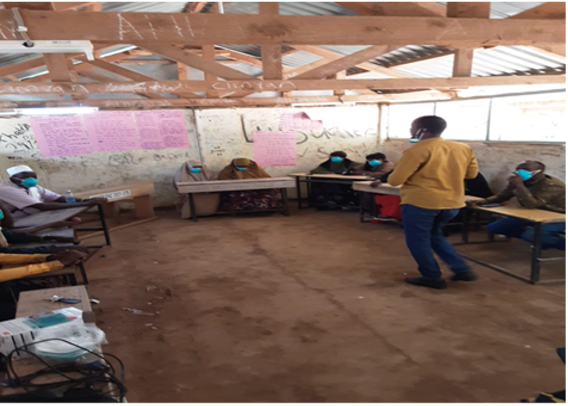
Moreover, documentation from the workshops – including attendance lists, photos and reflections- have shown equitable participation by both men and women in most workshops. Therefore, while gender continues to remain an important barrier to equity in an overwhelmingly patriarchal context, the work of student-teachers demonstrates that gender-sensitive strategies can be successfully implemented to ensure greater representation and work against social exclusions. The student-teachers have spoken directly to this point in acknowledging how the presence and active facilitation of the workshops on the part of female teachers played a decisive part in both recruitment and participation of other women, despite some initial resistance by male participants. Additionally, some of the groups of student-teachers operationalized principles of inclusivity and social justice by ensuring that participants living with disabilities would also be included. In turn they have learned that the differences between perspectives enrich the process and that greater inclusivity ultimately means stronger and more equitable grounds to imagine the “just schools” of tomorrow. However, they have also grown aware that the statement “diversity is key”, implies much and intensive (behind the scenes) labor: preoccupation, deliberation, considerations, communication, organization, mobilization and, most importantly, resources.
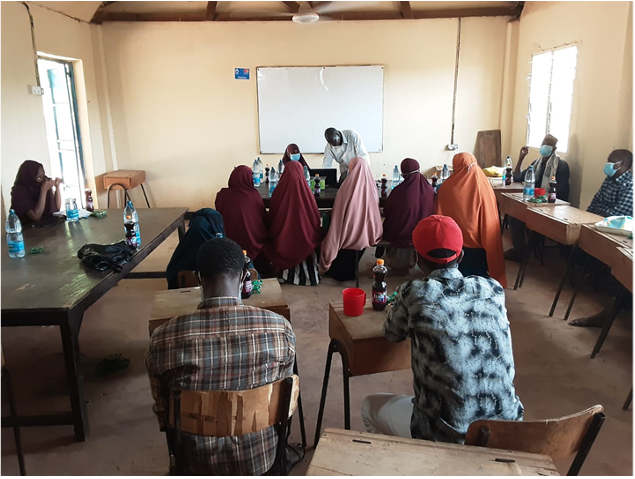
The inclusion of multiple voices and perspectives requires a planned and conscious effort by all to de-center, to limit one’s speaking in the interest of welcoming another’s voice. All of this requires time, work and resources. Given the presence of multiple languages in the multi-ethnic communities living in Refugee Complex in Dadaab, successful engagement of parents and families often required the explicit designation of time for the work of translators and interpreters and mobilization of resources to ensure their availability. For example, without transportation stipends, our KSL interpreters would not have been able to attend the workshops. In the absence of these physical bridges and/or connectors who work “for the other”, some participants might have otherwise been easily marginalized, or even excluded from these spaces of dialogue.
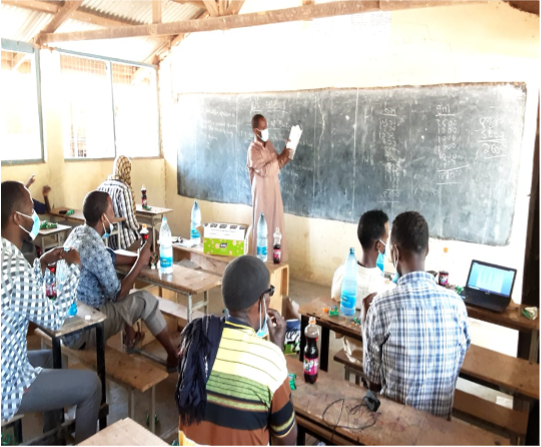
Finally, as we reflect on the end of this first term of the practicum course, we continue to think about the role played by technology (and specifically digital technologies) in connecting – despite many limits- those whose bodies would have otherwise been separated by geography or history, through space and time. As with all other courses organized by BHER, seven (7) time zones and thousands of miles run between course directors in Canada and students in Kenya and Somalia. Thus, the course facilitators resort to online platforms such as Zoom for synchronous sessions and Eclass (MOOCS) and WhatsApp to share contents, materials and communications with students. Digital technologies have also allowed students who have relocated outside of Dadaab, or even Kenya, for employment and family reasons, to continue engaging with the course and participating in the workshop delivery alongside their colleagues. Nevertheless, we also acknowledge that without the necessary motivation and commitment to adopt digital technologies in a more inclusive and just direction, their mere availability can bring no progress of its own.
In conclusion, we therefore wish to highlight how the successes stated above have not been the result of technology, but of an immense motivation and commitment to work both independently and collectively on the part of all student-teachers and the teaching team. Of those students who continue to find the strength to push forward remotely and independently as well as their fellow group members who ensured that their colleagues from afar would be included in decisions and meetings. It is their persistent coordination and communication, their insistence on making time for the other, that gave meaning to the possibilities presented by instant communication technologies. Moreover, the distances between course directors and the complex geopolitical locations of the workshops has been sutured through the incredible work and commitment of the Peer Mentors in the course. They are recent graduates of the MA in Education at York University through BHER, who not only support the students and oversee the implementation of course directors’ plans on the ground but most importantly maintain ongoing dialogue with both the course directors and students. In their absence, an experiential course like the practicum would be impossible, technology notwithstanding. As course directors, there is much that we are learning from them and much that we have yet to learn about the hope and meanings that education holds for humanity.
The full videorecording of the Workshop portfolio presentations can be found here: https://www.youtube.com/watch?v=tOM8lv9MHX0
REFERENCES
Amunga, J., Were, D., Ashioya, I. (2020). The Teacher-Parent Nexus in the Competency Based Curriculum Success Equation in Kenya. International Journal of Educational Administration and Policy Studies, 12 (1), 60-76 https://doi.org/10.5897/IJEAPS2020.0646
Ishimaru, A. M. (2020). Just schools: Building equitable collaborations with families and communities. New York, NY: Teachers College Press.
Kenya Institute of Curriculum Development. (2019a). Basic Education Curriculum Framework. BASIC-EDUCATION-CURRICULUM-FRAMEWORK-2019.pdf (kicd.ac.ke)
Kenya Institute of Curriculum Development. (2019b). Guidelines of Parental Empowerment and Engagement. Guidelines on Parental Empowerment and Engagement : Kenya Institute of Curriculum Development (kicd.ac.ke)
Kenya Institute of Curriculum Development. (2021). Popular Slides on CBC. Kenya Institute of Curriculum Development. Popular Slides on CBC : Kenya Institute of Curriculum Development (kicd.ac.ke)
Nishimura, M. (2017, March). Community Participation in School Management in Developing Countries. Oxford Research Encyclopedia of Education. Retrieved from http://education.oxfordre.com/view/10.1093/acrefore/9780190264093.001.0001/acrefore-9780190264093-e-64
Wafubwa, R. N. (2021). Challenges of Teaching and Assessing the 21st-Century Competencies in Africa: A focus on the Kenyan New Curriculum of Basic Education. East African Journal of Education Studies, 3(1), 96-105. https://doi.org/10.37284/eajes.3.1.332