By Riya Bhatla
March 2026
Research Assistant Riya Bhatla reflects on ‘ruptures’ in research through her work on Borderless Graduate Education and the Politics of Knowledge Production, a SSHRC-funded Insight Development Grant project exploring both the significance of, and possibilities for, master’s programming for refugees through the experiences of BHER graduate alumni.
In the hallway of my elementary school, there is a tile that I painted when I was seven years old. The prompt, “What do you want to be when you grow up?” led to me painting my future self, pointing towards a chalkboard. I was a teacher, standing before my class and instructing them on a rather simplistic math problem.
Since painting that tile, every path I followed brought me to the world of education. Whether it was volunteering in my community, pursuing a teaching degree, or working in post-secondary institutions, I was deeply immersed in and inspired by the educational. There was something so intriguing about being able to guide future generations as they made sense of our ever-changing world; one that I came to know as driven by politics, power-infused, impartially structured, and somehow, completely ungraspable.
Throughout my undergraduate journey, I developed an interest in research. I was fascinated by the possibility of uncovering more of this seemingly “ungraspable” world and seeking out perspectives that were historically left out of the conversation. I truly believed that engaging in research would enable me to be more aware of our deeply intricate relations – to our histories and to each other. I was (and still am) confident that research has generative, transformative possibilities; it not only highlights what is, but it also paves the way for what can be.
Within my fascination, there was also critique, as I considered the contradictions of research operating as a form of knowledge legitimization, but imposing restrictions on who can contribute to this process. I wondered about the politics of research, challenges in entering the space, educational “credentials” that were attributed such significance, and the hierarchies that exist within the research realm.
The BHER project eliminated the barriers produced by the world of “academia” by providing a space for refugee scholars to develop meaningful research projects, engage through international forums, and advocate both within their camps and beyond. When Dr. Silver invited me to join a research project in connection to BHER, I could not be more excited.
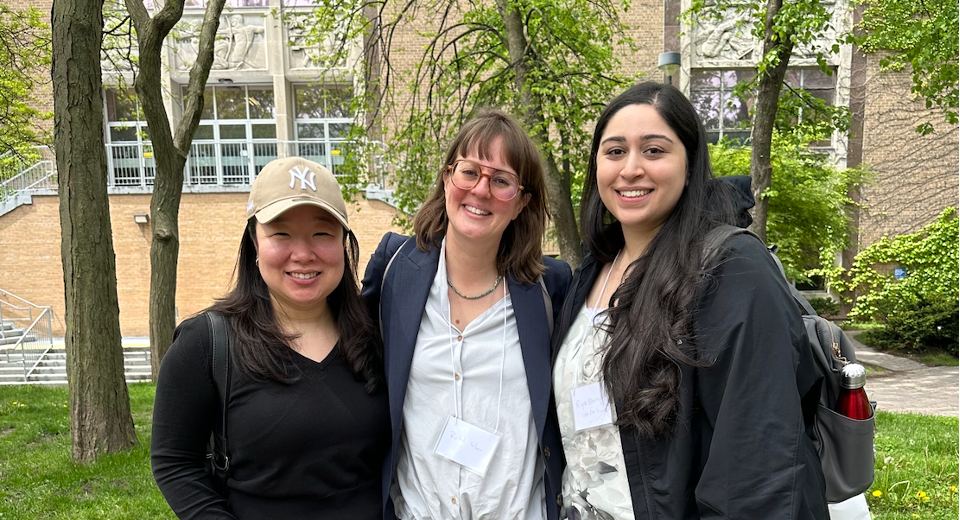
Our team was researching the experiences of the first master’s degree recipients at the Dadaab Refugee Camps in Kenya, considering the impact of graduate certification on economic outcomes, personal development, and most significantly, possibilities for localizing knowledge production. What made this project especially insightful was the fact that it involved collaboration with two scholars from the camps who had their own experience developing research projects on issues that directly impacted their community.
From transcribing interviews to learning about the coding process to presenting at a local conference, I became fully immersed in what I had always envisioned it was like to be a “scholar.” I learned about challenges in accessing funding, the complexities that come with engaging in transnational research, and the importance of maintaining reciprocal and respectful relationships with research collaborators.
I was also consistently aware, and critical, of the fact that our research team would be subject to the constraints of bureaucracy, distance, and time. Personal lives and culturally intricate conceptualizations of one’s relationship to the research process added further depth to our means of relating to one another. Unfortunately, the only time that all five of us were together was over Zoom, with internet access challenges resulting in increased limitations on the timewe could spend together. While we all shared the same investments in our project, we all had different means of enacting those investments, which was often out of our control.
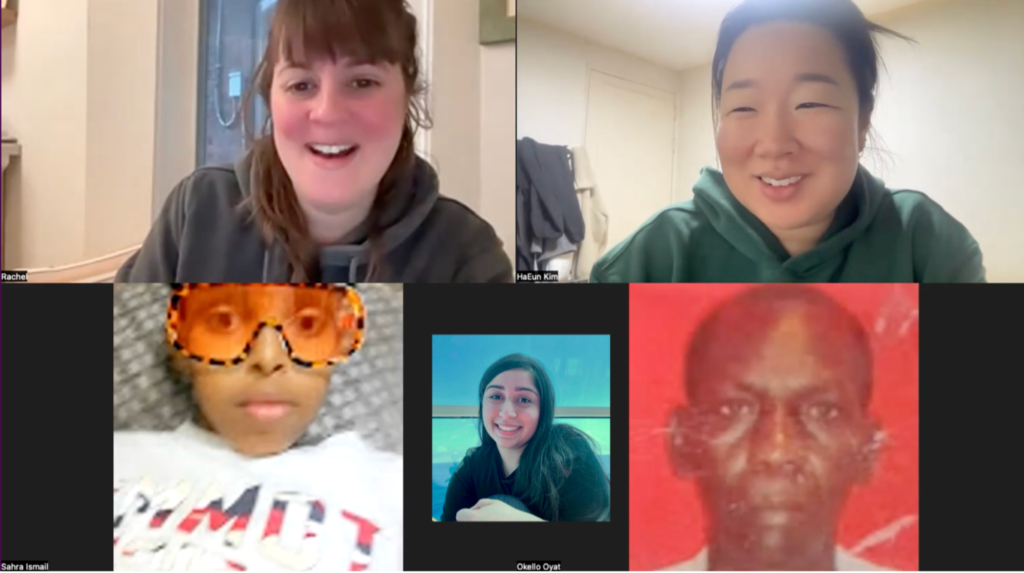
Yet, what was particularly unique about this project was our decision to employ collaborative autoethnography to capture our reflections, feelings, and critical inner dialogues on these very challenges. As we underwent various stages of the research process, we journalled, taking note of strengths, tensions, and what I would describe as the inevitable arrival of “ideological ruptures.”
A “rupture” may constitute a moment when a reality comes into direct contact with one’s taken-for-granted “truths.” It is a moment of deconstruction, re-evaluation, hesitation, and “disorientation.” As Sara Ahmed argues in her book Queer Phenomenology: Orientations, Objects, Others, our feelings of “disorientation” can provide great insight, because they shed light on what it is that we are orientated towards (2008). “Rupturing” moments help us evaluate how we might be complicit and implicated in the very tensions that our work aims to address, forcing us to contend with uncomfortable realizations.
For me, this “ideological rupture” was living with the feeling of simultaneous gratitude and self-interrogation, as a racialized student in a western post-secondary institution. When being exposed to the realities of forced migration through a transnational research project, I was reminded of Daswani’s 2021 work, “The (Im)Possibility of Decolonizing Anthropology.” Daswani writes about the contradictions of striving for the decolonial while navigating academia, which privileges those who “walk the walk” and “talk the talk” of whiteness (2021). I could not help but consider the hypocrisies of writing to the potential of localized knowledge production (a deeply decolonial act) while being bound to the languages and politics of neocolonial knowledge production.
I also could not help but consider that my entrance into this project was meeting an enthusiastic professor who appreciated my work, while my collaborators’ entrance was predicated on their experiences with forced migration. Had they never encountered BHER as a refugee, they may have never been involved in this project as a scholar. Ironically, access to localized knowledge production measures often became dependent on access to educational programs delivered by western institutions. An “ideological rupturing” is what forced us to mediate between the proven benefits and transformation produced through the BHER project and the ongoing bureaucratic, economic, and political constraints of academia.
While there may not have been any clearcut “solution,” over time, I came to understand that responsible research lies in our hesitation, our reluctance, or perhaps, our discomfort. Engaging in collaborative autoethnography enabled our team to dwell within those “ruptures.” It is what allowed us to champion the responsibility of including the perspectives of all collaborators, while being mindful of the fact that we are all differentially situated towards research. It is also what inspired the need to write a piece dedicated towards research methods.
In essence, our ideological “ruptures” remind us to critique how even in the pursuit of decolonial research, our orientations as researchers within academia may inevitably tie us to the neocolonial. To truly break free from these entanglements, there is a need to recognize how we have come to be, and perhaps stay, entangled.
References
Ahmed, S. (2008). Queer phenomenology: orientations, objects, others. Duke University Press. https://doi.org/10.1515/9780822388074
Daswani, G. (2021, November 18). “The (Im)possibility of decolonizing anthropology.” Everyday Orientalism. https://everydayorientalism.wordpress.com/2021/11/18/the- impossibility-of-decolonizing-anthropology/